TravelersBuddy
information architecture • ux research • wcag guidelines • developer handoffs
You're finally doing it—planning that dream vacation! The excitement is real: epic views, amazing food, and spontaneous adventures. But before you can sip that beachside cocktail, reality kicks in. Flight comparisons, itinerary juggling, budget tracking—it’s enough to make you postpone the trip altogether. We set out to change that and asked -
How might we create a seamless, personalized trip-planning experience that reduces user stress?
Timeline
3 months
my role
Led UX research, accessibility audits, and information architecture redesign.
Led UX research, accessibility audits, and information architecture redesign.
Team
4 other UX design students
4 other UX design students
tools
Figma, Miro
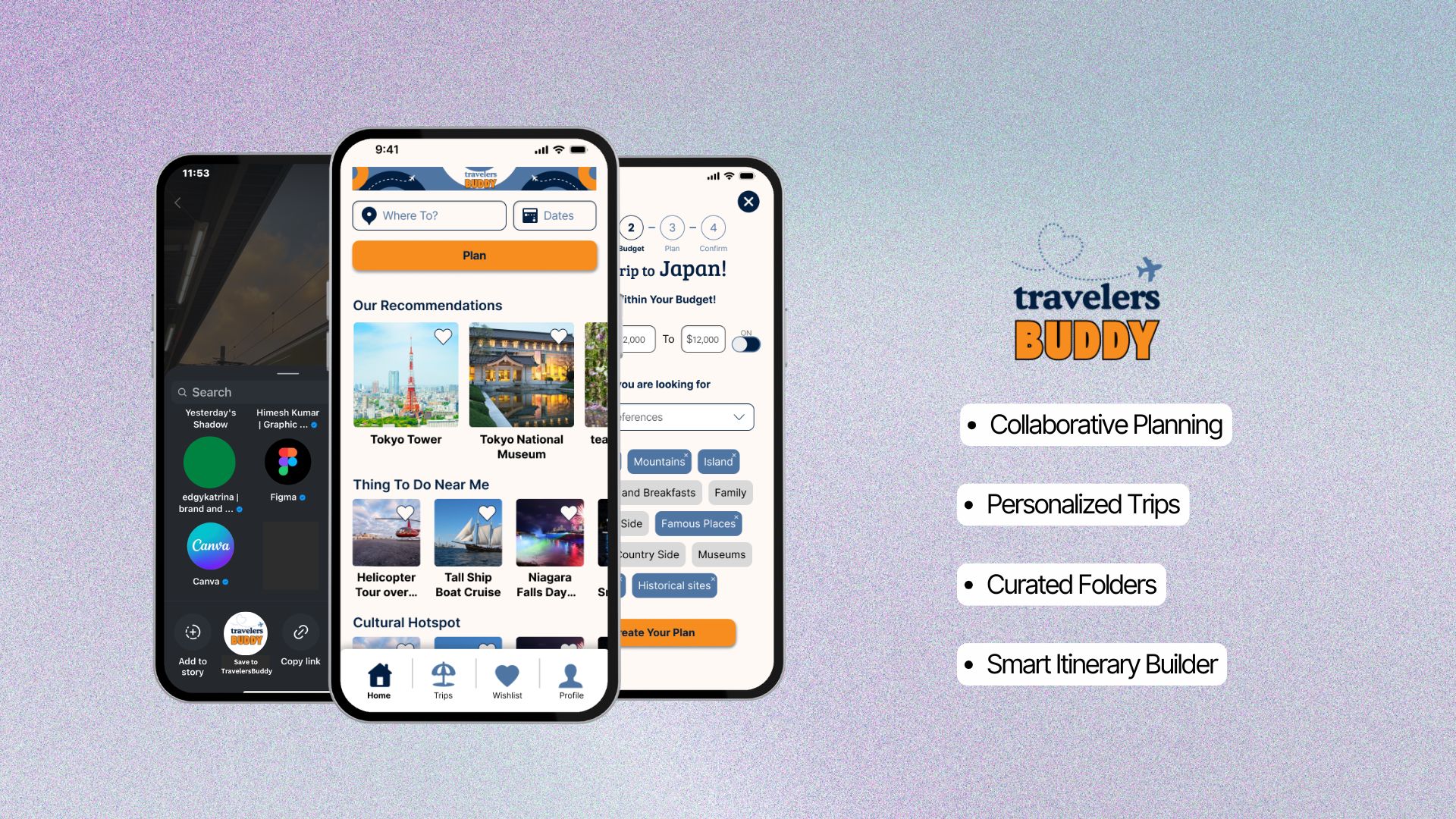
Project Overview
The Solution -
TravelersBuddy is a smart, collaborative travel planning tool that streamlines the entire trip-planning experience. It auto-organizes saved ideas from social media into curated folders, generates itineraries by pulling relevant wishlist items, and allows users to share plans with friends for seamless collaboration. With personalized suggestions based on user preferences, TravelersBuddy makes planning trips intuitive, organized, and tailored to each traveler’s needs.
My Role
Diving deep into competitive analysis and user interviews to understand existing travel planning solutions.
Crafted low and mid-fidelity wireframes that turned complex user needs into elegant solutions.
Carried out usability testing and iterated our solution design to refine the experience.
Took on the challenge of presenting the hard work of 4 months in under 4 minutes, ensuring that our ideas were communicated effectively to the experts.
Our Process
01
Discover
Refine the problem space, determine research priorities, and prepare a research plan.
02
Define
Conduct user research, analyze results, and identify the problem.
03
Design
Ideate and prioritize solutions, create user flows and wireframes, test interactive prototypes with users
04
Deliver
Iterate on designs, apply visual polish, present your final output
02
Define
Conduct user research, analyze results, and identify the problem.
03
Design
Ideate and prioritize solutions, create user flows and wireframes, test interactive prototypes with users
04
Deliver
Iterate on designs, apply visual polish, present your final output
Discovery Phase
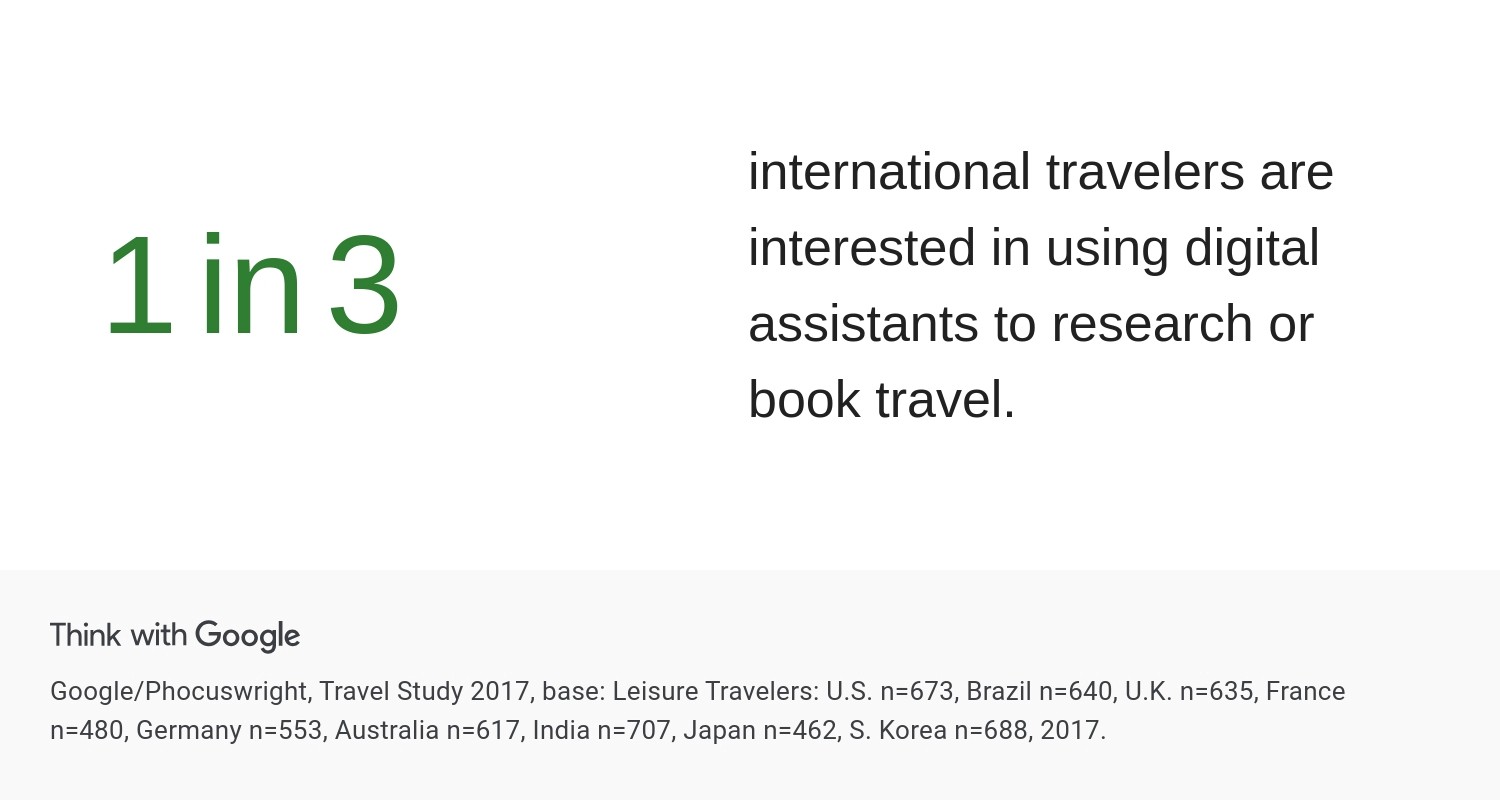
But what makes travel so stressful?
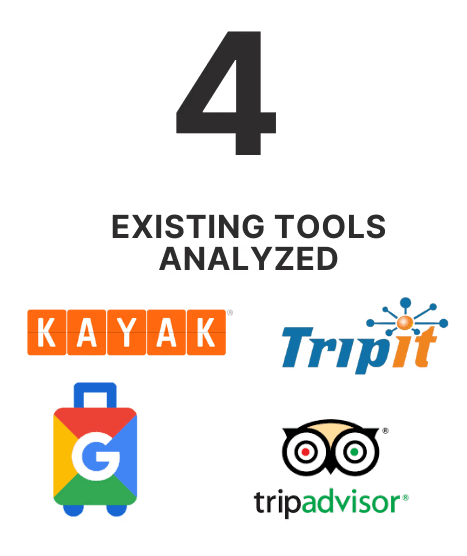
Tools like TripIt, Google Travel, Kayak, and TripAdvisor gave us a glimpse into existing solutions.
We discovered challenges such as fragmented experiences, overwhelming information, and a lack of personalization.
read the full analysis here.
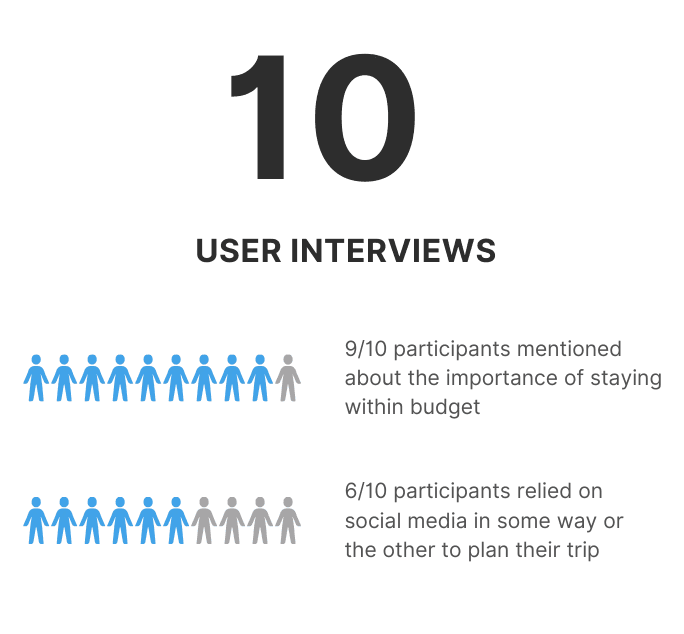
Through 10 interviews, we unearthed critical insights.
Travelers wanted -
easy itinerary sharing
cost-effective planning
tools that adapted to their preferences.
Our research highlighted the following problems in existing solutions-
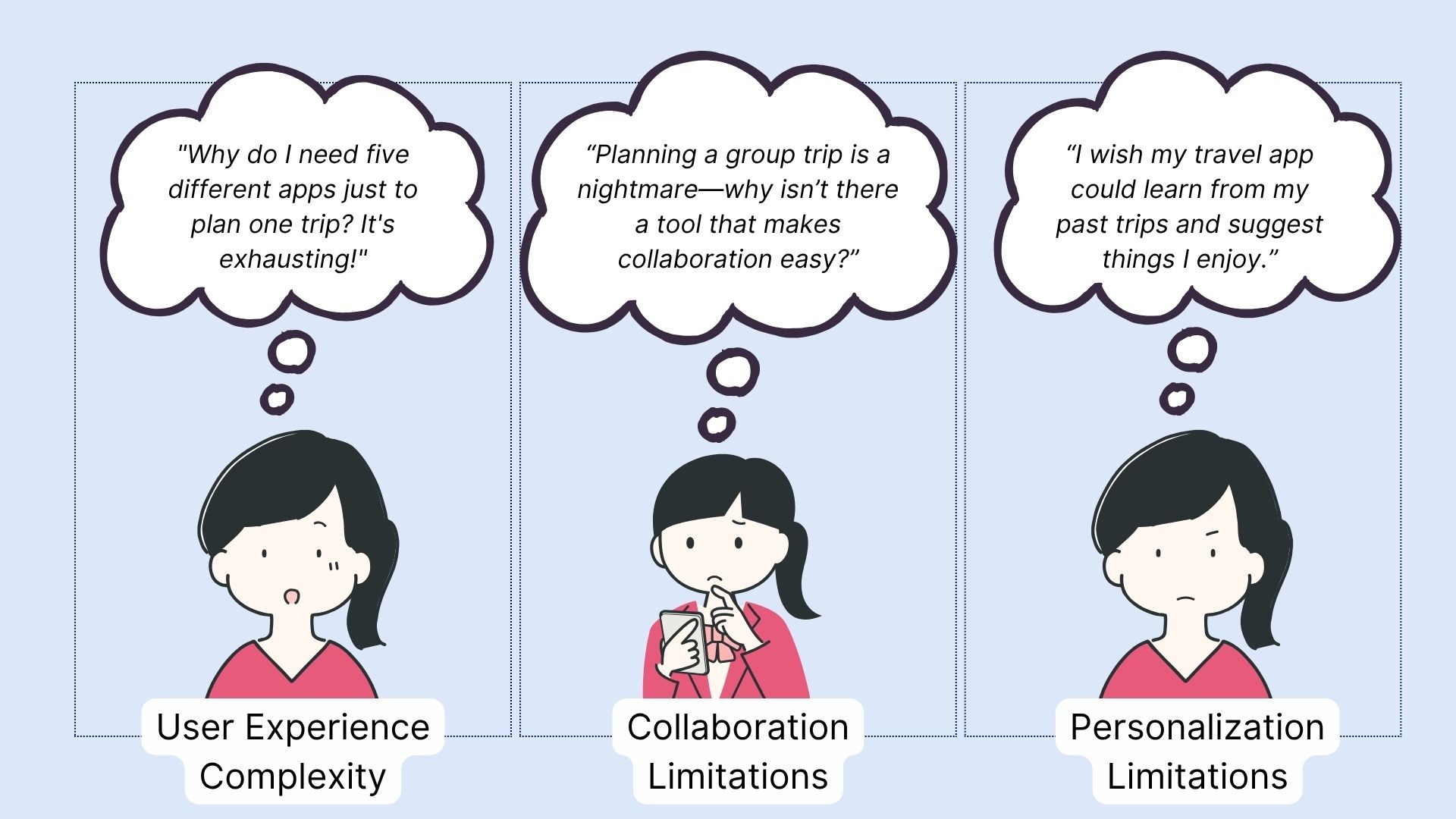
View the annotated affinity diagram here.
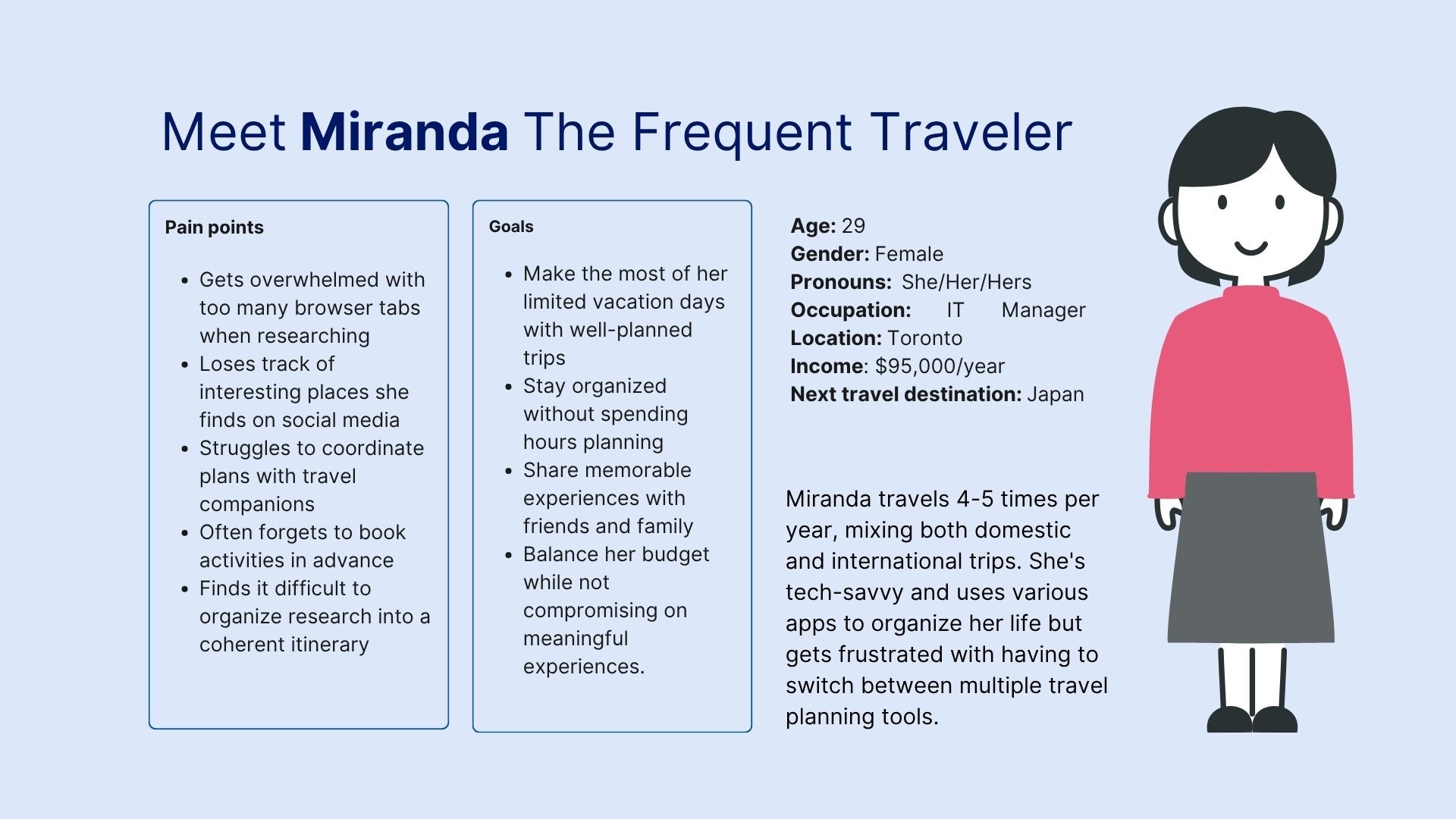
"I love being on vacation, but trip planning? That’s a job I’d outsource in a heartbeat!"
- Miranda
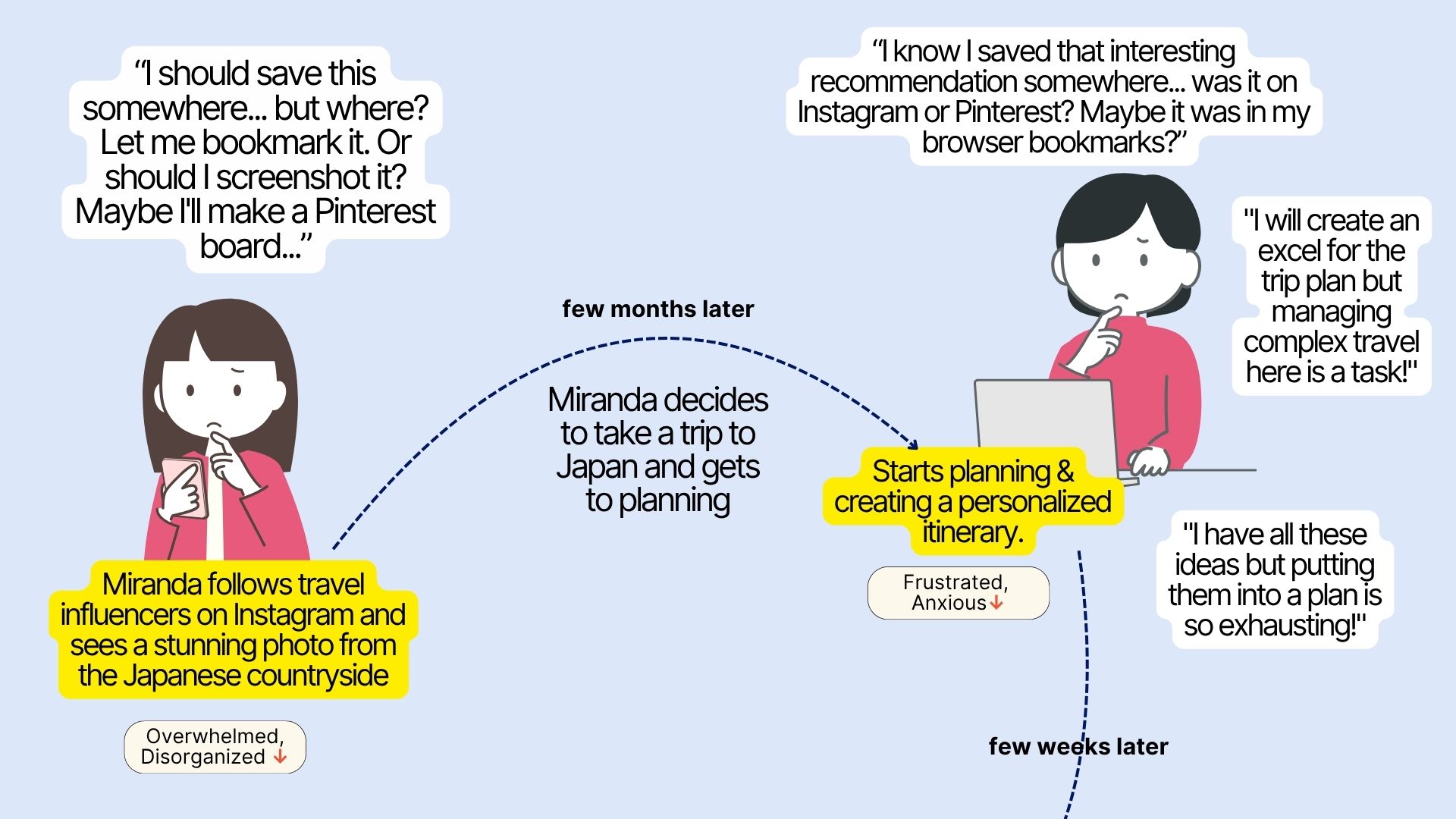
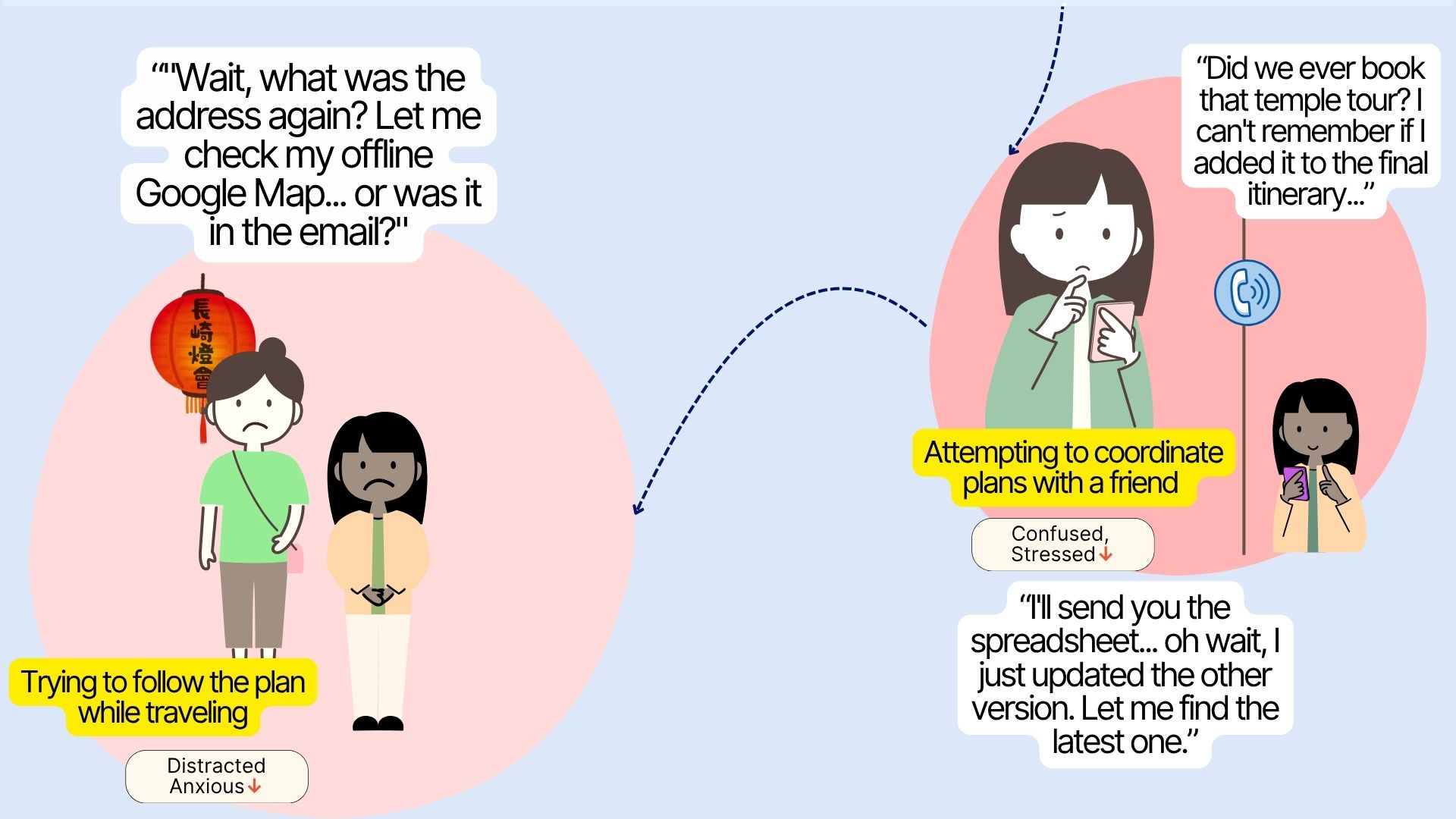
So, who is Miranda?
Define
How might we create a seamless, personalized trip-planning experience that reduces user stress?
The Crazy 8s
To expand on our thought process, we utilized "the crazy 8" exercises to extract the ideas that had been forming in our heads since the research phase. Our brainstorming session entailed 5-minute intervals of 8 sketches. I did not compose eight sketches, but this exercise forced me to push out ideas. This was a great exercise to get my ideas on paper.
After this exercise, we transferred our ideas to stickies and prioritized our features to finalize our final features.
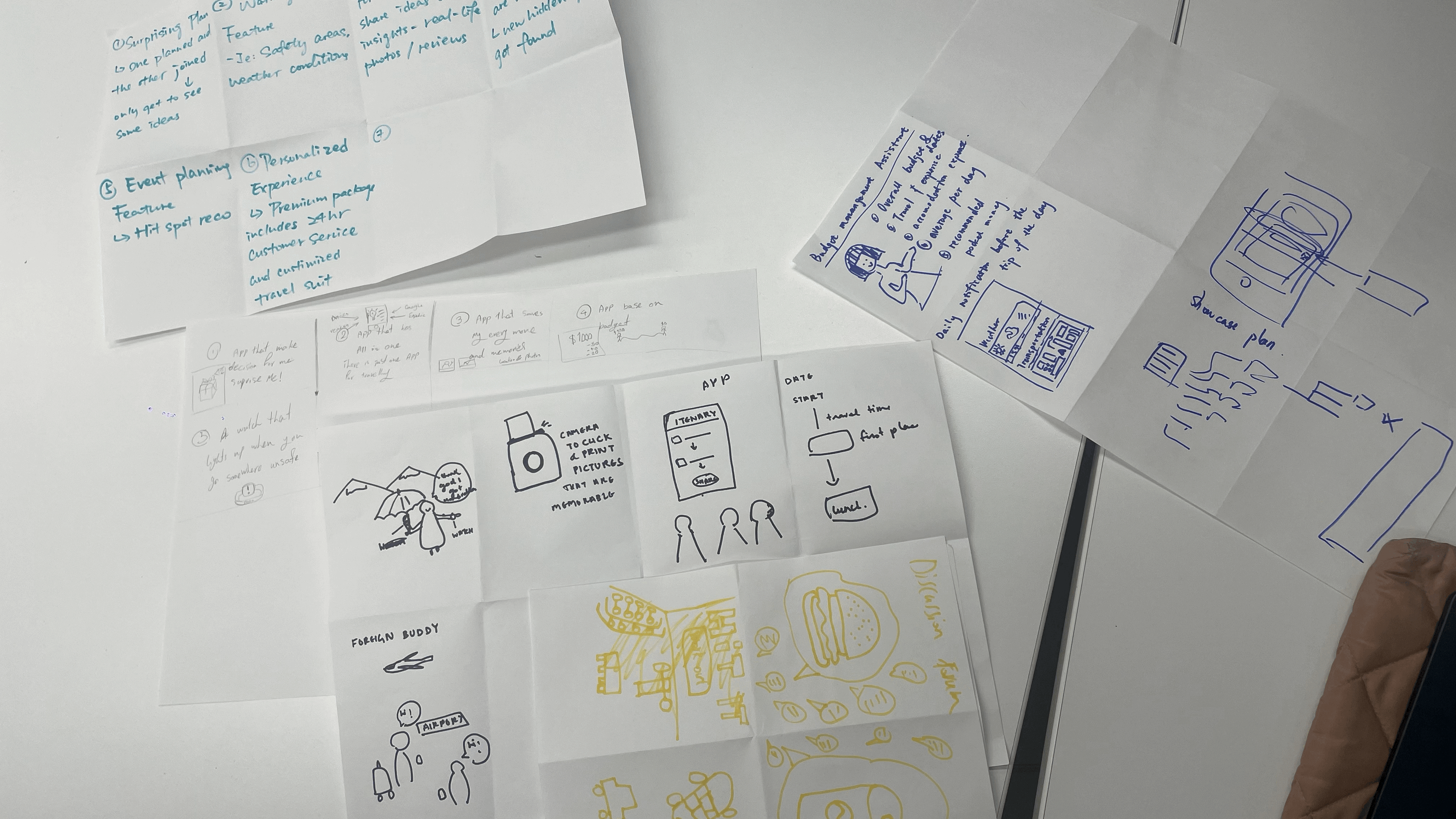
Prioritized features for this project-
Curated Folders
Shortlisted places and trip ideas from different social media will be automatically organized into curated folders in the wishlist.
Share the plan
Share the trip plan with your travel buddies for better collaboration.
Intelligent Itinerary Creation
When planning a trip to a certain place, the app will automatically pull applicable wishlist items into itineraries, eliminating the task of cross-referencing.
Personalized Itinerary
Generate personalized Itinerary using user preferences.
Design
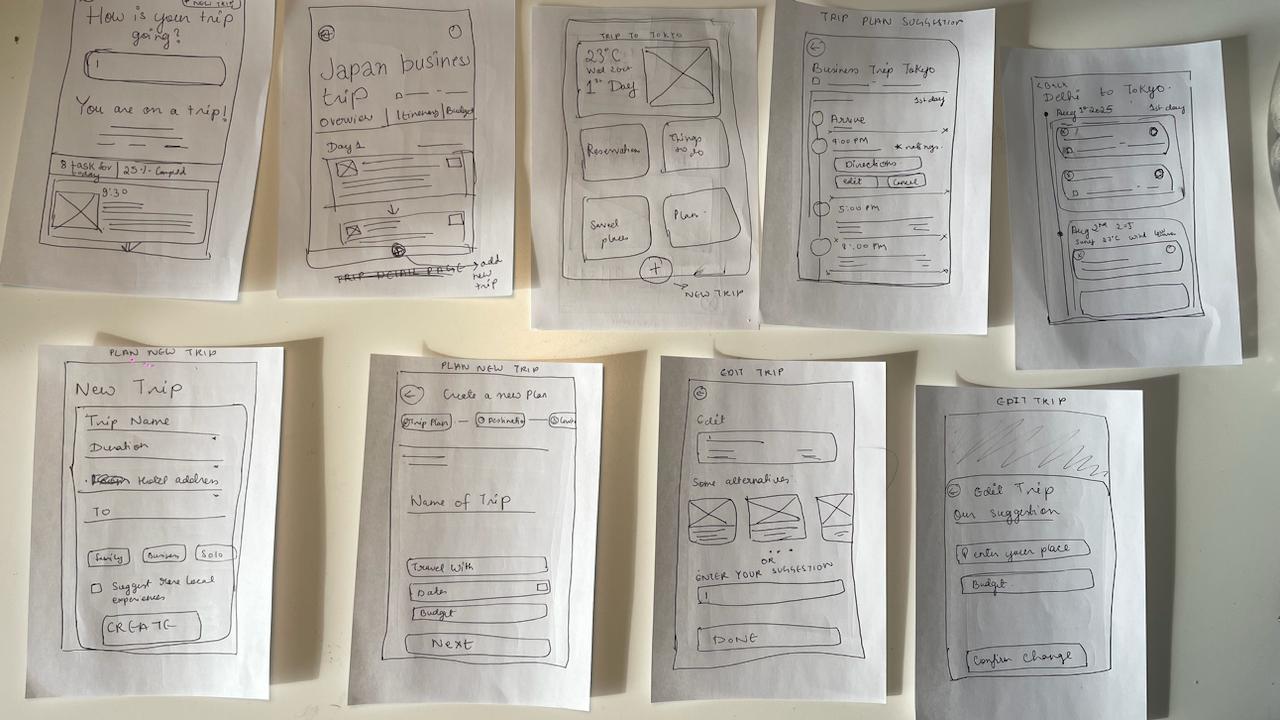
We finalized our key user screens (wishlist, profile, explore etc.) and sketched at least two options for each screen. Once every team member had sketched at least 2 options, our team met again to discuss our UI sketches.
We then picked the best parts from our designs, keeping in mind our users.
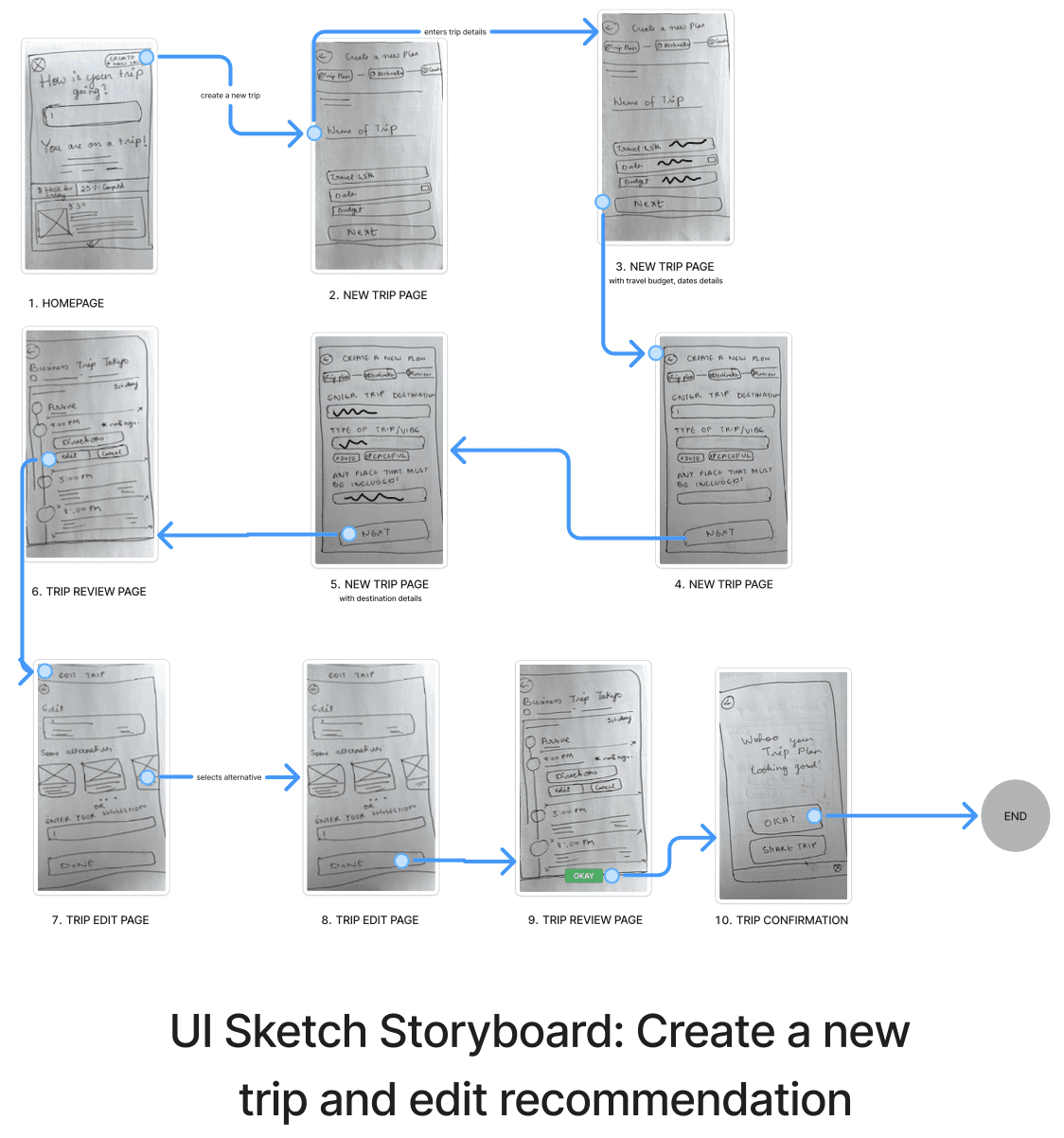
The next step was the creation of lo-fi wireframes and creating a prototype for user testing. We as a team had decided on a usability script and the task we would ask to be carried out.
I gained some really useful insights by observing the participants and the way they complete a task.
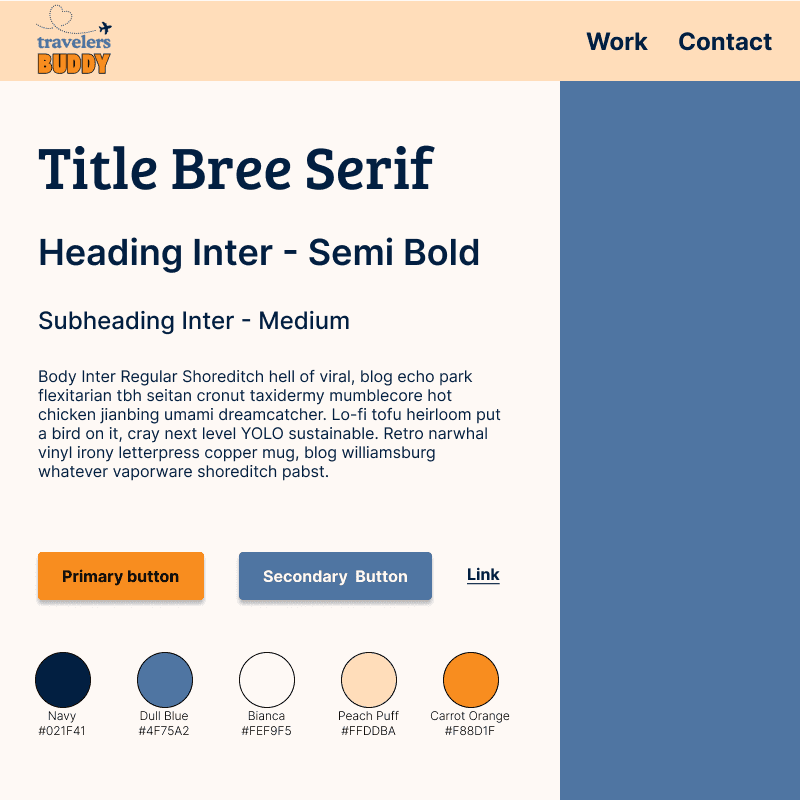
The brand color palette balances energy, tranquility, and is WCAG 2.0 level AA. Vibrant orange brings dynamic energy to key interaction points, particularly the call-to-action buttons like "Plan Trip," while a subtle, lighter background creates visual harmony.
The typography emphasizes clean, straightforward fonts that prioritize readability, ensuring users can easily navigate their journey from start to finish.
Deliver
Through rigorous usability testing, we continuously refined our vision.
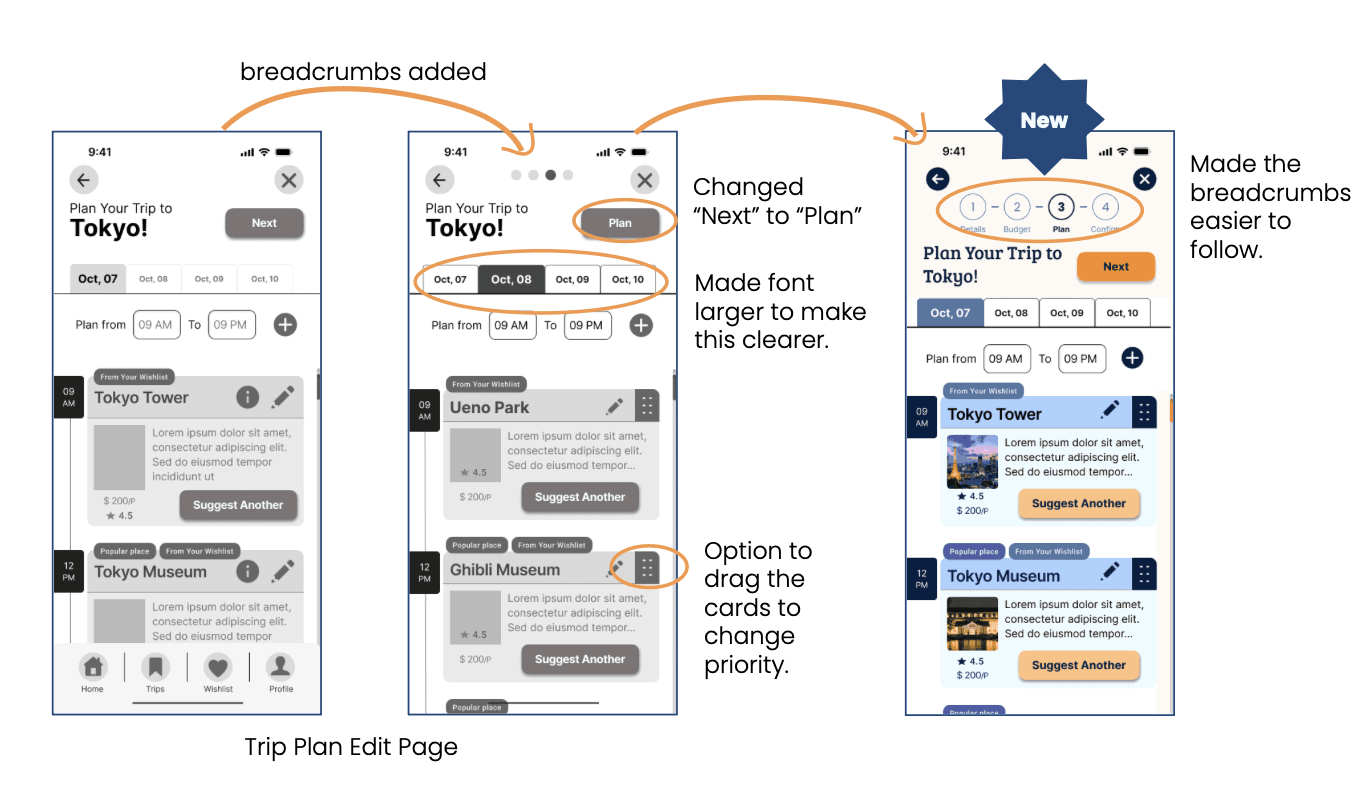
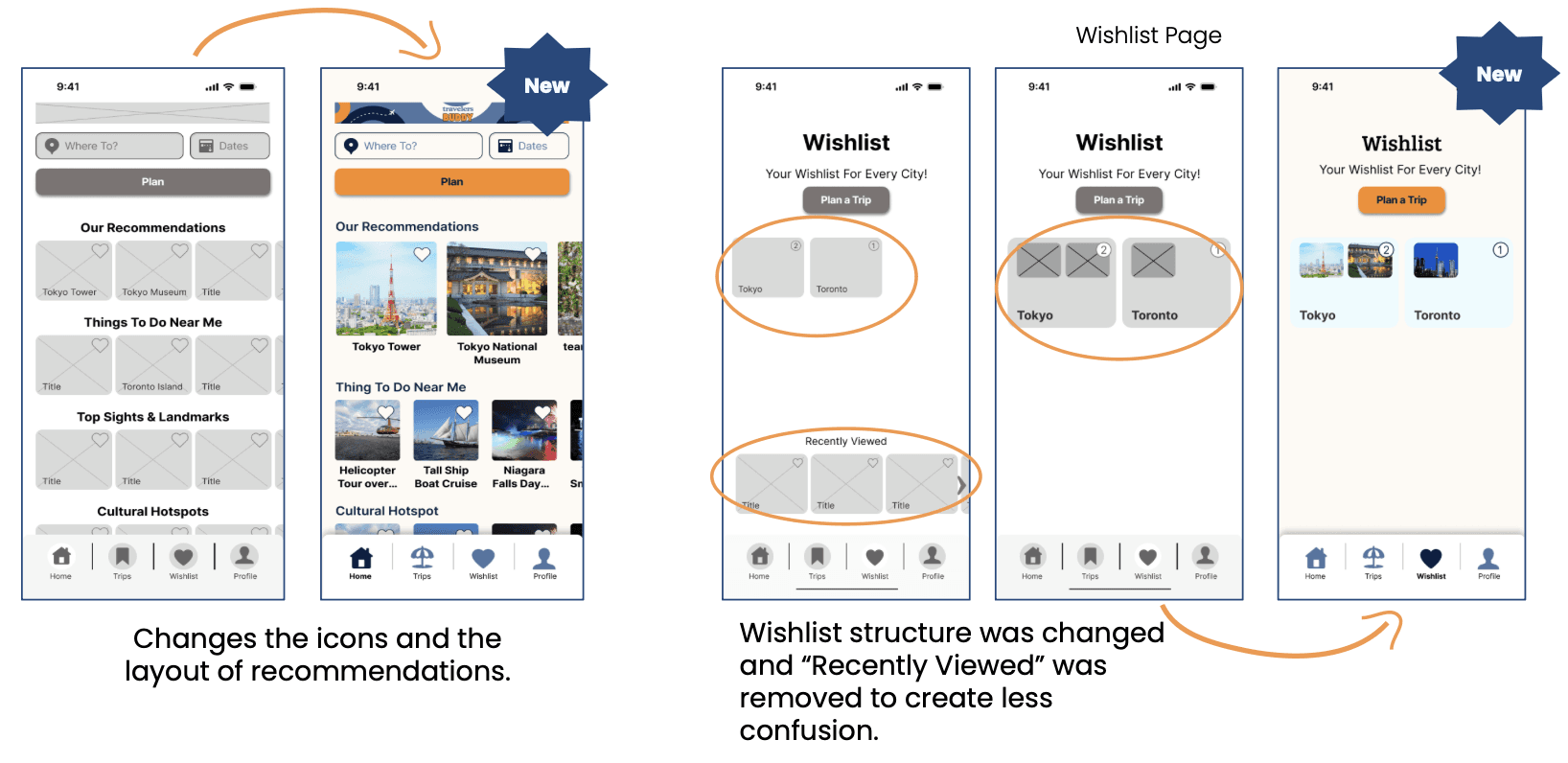
What differentiates our app from others in the market?
While we initially highlighted curated folders as a key feature, we felt this wasn’t a strong enough differentiator. Determined to address this, I took it upon myself to identify another unique aspect that could set our app apart.
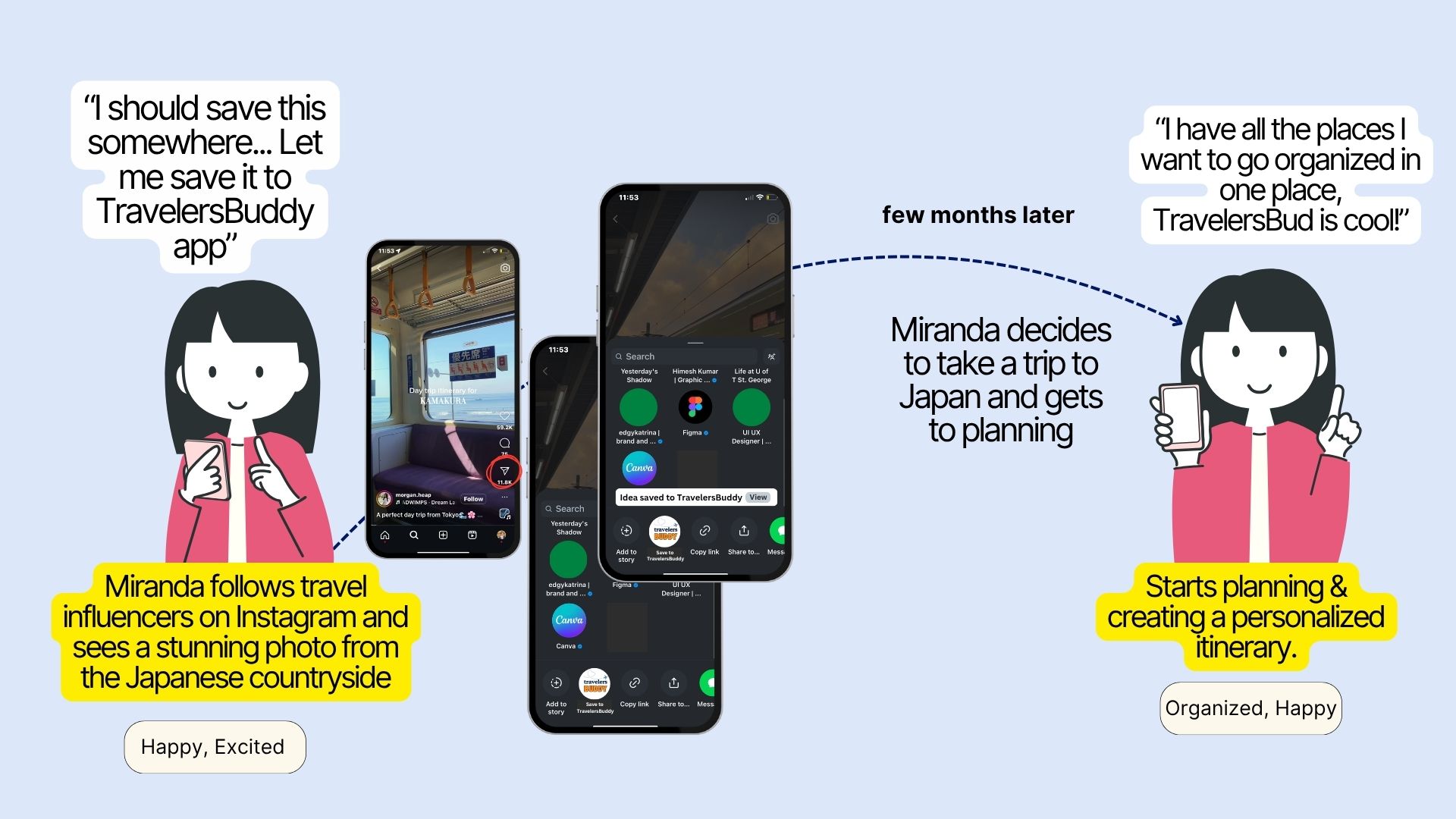
Through user interviews, we uncovered an interesting insight: social media plays a major role in travel planning. 6 out of 10 participants mentioned social media as a key influence in their decision-making process. However, we also identified a major pain point: users struggle to save and revisit travel ideas they discover on platforms like Instagram and TikTok. Once they like a post, it often gets lost in their feed, making it difficult to refer back to when they start planning their trip.
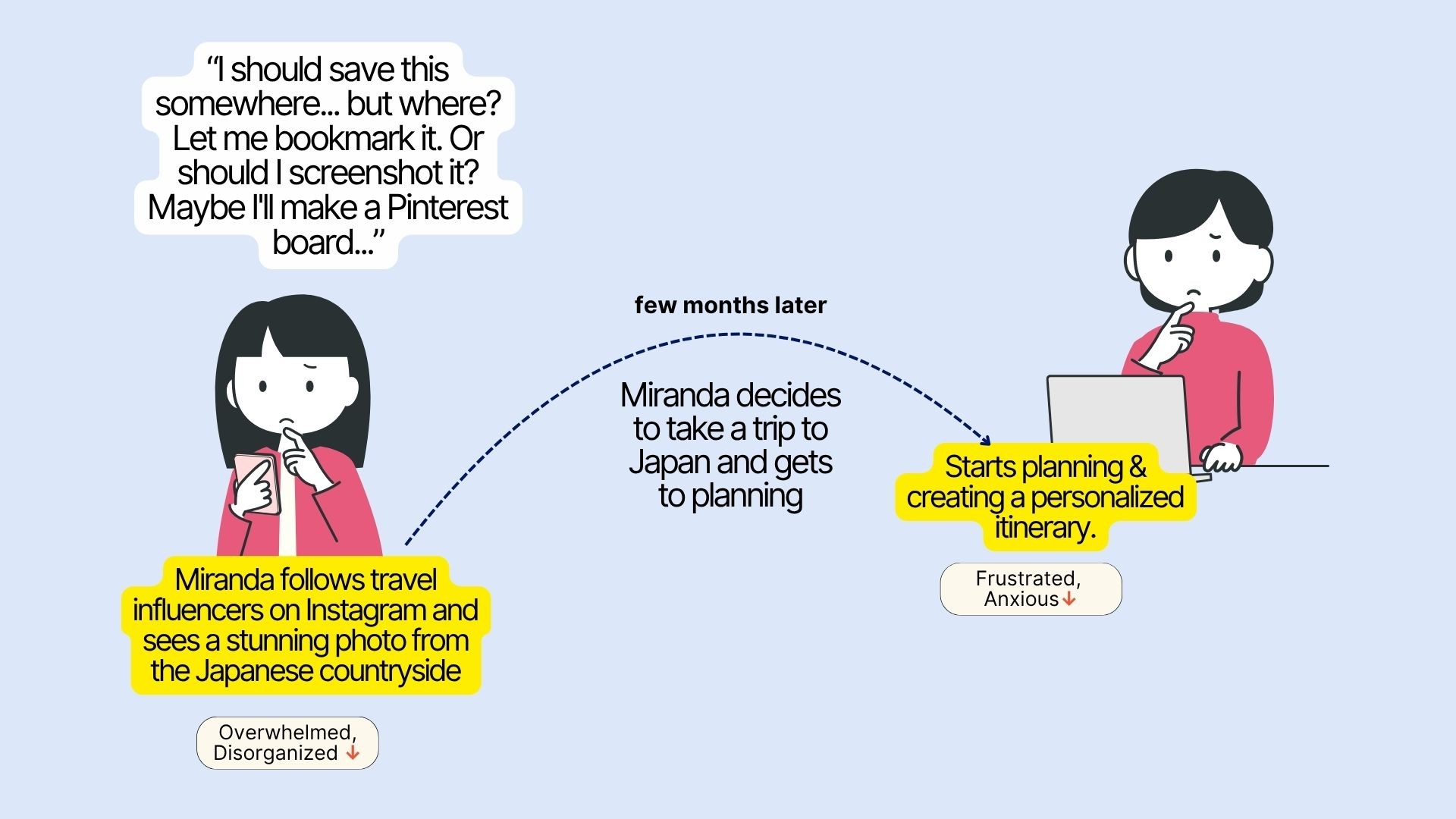
By targeting this specific problem, we found an opportunity to create a seamless experience where users can save, organize, and access travel inspirations directly from social media, ensuring they never lose track of their favorite ideas.
Learnings
Falling in Love with User Research
Conducting interviews and diving into user insights made me realize how much I enjoy understanding people's needs, frustrations, and behaviors. User research became my favorite part of the process!
Crazy Ideas Can Lead to Big Solutions
During an exciting ideation activity, I discovered that I could dream up bold, unconventional solutions in just four minutes. This fast-paced creativity helped me embrace the power of rapid problem-solving.
Presenting with Impact
I was happy to be recognized as the best presenter by our TA, which gave me the confidence to believe in my ability to communicate design solutions effectively.
A UX Journey Worth Pursuing
From discovery to final presentation, I loved every step of the UX process. This project reinforced my decision to transition from software development to UX—I'm on the right path, and I can't wait to keep growing in this field!
Pictured: Presenting my UX project with the same energy as a TED Talk speaker. 😎
TravelersBuddy
information architecture • ux research • wcag guidelines • developer handoffs
You're finally doing it—planning that dream vacation! The excitement is real: epic views, amazing food, and spontaneous adventures. But before you can sip that beachside cocktail, reality kicks in. Flight comparisons, itinerary juggling, budget tracking—it’s enough to make you postpone the trip altogether. We set out to change that and asked -
How might we create a seamless, personalized trip-planning experience that reduces user stress?
Timeline
3 months
my role
Led UX research, accessibility audits, and information architecture redesign.
Team
4 other UX design students
tools
Figma, Miro
Project Overview
The Solution -
TravelersBuddy is a smart, collaborative travel planning tool that streamlines the entire trip-planning experience. It auto-organizes saved ideas from social media into curated folders, generates itineraries by pulling relevant wishlist items, and allows users to share plans with friends for seamless collaboration. With personalized suggestions based on user preferences, TravelersBuddy makes planning trips intuitive, organized, and tailored to each traveler’s needs.
My Role
Diving deep into competitive analysis and user interviews to understand existing travel planning solutions.
Crafted low and mid-fidelity wireframes that turned complex user needs into elegant solutions.
Carried out usability testing and iterated our solution design to refine the experience.
Took on the challenge of presenting the hard work of 4 months in under 4 minutes, ensuring that our ideas were communicated effectively to the experts.
Our Process
01
Discover
Refine the problem space, determine research priorities, and prepare a research plan.
02
Define
Conduct user research, analyze results, and identify the problem.
03
Design
Ideate and prioritize solutions, create user flows and wireframes, test interactive prototypes with users
04
Deliver
Iterate on designs, apply visual polish, present your final output
02
Define
Conduct user research, analyze results, and identify the problem.
03
Design
Ideate and prioritize solutions, create user flows and wireframes, test interactive prototypes with users
04
Deliver
Iterate on designs, apply visual polish, present your final output
Discovery Phase
But what makes travel so stressful?
Tools like TripIt, Google Travel, Kayak, and TripAdvisor gave us a glimpse into existing solutions.
We discovered challenges such as fragmented experiences, overwhelming information, and a lack of personalization.
Through 10 interviews, we unearthed critical insights.
Travelers wanted -
easy itinerary sharing
cost-effective planning
tools that adapted to their preferences.
Our research highlighted the following problems in existing solutions-
View the annotated affinity diagram here.
"I love being on vacation, but trip planning? That’s a job I’d outsource in a heartbeat!"
- Miranda
So, who is Miranda?
Define
How might we create a seamless, personalized trip-planning experience that reduces user stress?
The Crazy 8s
To expand on our thought process, we utilized "the crazy 8" exercises to extract the ideas that had been forming in our heads since the research phase. Our brainstorming session entailed 5-minute intervals of 8 sketches. I did not compose eight sketches, but this exercise forced me to push out ideas. This was a great exercise to get my ideas on paper.
After this exercise, we transferred our ideas to stickies and prioritized our features to finalize our final features.
Prioritized features for this project-
Curated Folders
Shortlisted places and trip ideas from different social media will be automatically organized into curated folders in the wishlist.
Share the plan
Share the trip plan with your travel buddies for better collaboration.
Intelligent Itinerary Creation
When planning a trip to a certain place, the app will automatically pull applicable wishlist items into itineraries, eliminating the task of cross-referencing.
Personalized Itinerary
Generate personalized Itinerary using user preferences.
Design
We finalized our key user screens (wishlist, profile, explore etc.) and sketched at least two options for each screen. Once every team member had sketched at least 2 options, our team met again to discuss our UI sketches.
We then picked the best parts from our designs, keeping in mind our users.
The next step was the creation of lo-fi wireframes and creating a prototype for user testing. We as a team had decided on a usability script and the task we would ask to be carried out.
I gained some really useful insights by observing the participants and the way they complete a task.
The brand color palette balances energy, tranquility, and is WCAG 2.0 level AA. Vibrant orange brings dynamic energy to key interaction points, particularly the call-to-action buttons like "Plan Trip," while a subtle, lighter background creates visual harmony.
The typography emphasizes clean, straightforward fonts that prioritize readability, ensuring users can easily navigate their journey from start to finish.
Deliver
Through rigorous usability testing, we continuously refined our vision.
What differentiates our app from others in the market?
While we initially highlighted curated folders as a key feature, we felt this wasn’t a strong enough differentiator. Determined to address this, I took it upon myself to identify another unique aspect that could set our app apart.
Through user interviews, we uncovered an interesting insight: social media plays a major role in travel planning. 6 out of 10 participants mentioned social media as a key influence in their decision-making process. However, we also identified a major pain point: users struggle to save and revisit travel ideas they discover on platforms like Instagram and TikTok. Once they like a post, it often gets lost in their feed, making it difficult to refer back to when they start planning their trip.
By targeting this specific problem, we found an opportunity to create a seamless experience where users can save, organize, and access travel inspirations directly from social media, ensuring they never lose track of their favorite ideas.
Learnings
Falling in Love with User Research
Conducting interviews and diving into user insights made me realize how much I enjoy understanding people's needs, frustrations, and behaviors. User research became my favorite part of the process!
Crazy Ideas Can Lead to Big Solutions
During an exciting ideation activity, I discovered that I could dream up bold, unconventional solutions in just four minutes. This fast-paced creativity helped me embrace the power of rapid problem-solving.
Presenting with Impact
I was happy to be recognized as the best presenter by our TA, which gave me the confidence to believe in my ability to communicate design solutions effectively.
A UX Journey Worth Pursuing
From discovery to final presentation, I loved every step of the UX process. This project reinforced my decision to transition from software development to UX—I'm on the right path, and I can't wait to keep growing in this field!
Pictured: Presenting my UX project with the same energy as a TED Talk speaker. 😎
TravelersBuddy
information architecture • ux research • wcag guidelines • developer handoffs
You're finally doing it—planning that dream vacation! The excitement is real: epic views, amazing food, and spontaneous adventures. But before you can sip that beachside cocktail, reality kicks in. Flight comparisons, itinerary juggling, budget tracking—it’s enough to make you postpone the trip altogether. We set out to change that and asked -
How might we create a seamless, personalized trip-planning experience that reduces user stress?
Timeline
3 months
my role
Led UX research, accessibility audits, and information architecture redesign.
Team
4 other UX design students
tools
Figma, Miro
Project Overview
The Solution -
TravelersBuddy is a smart, collaborative travel planning tool that streamlines the entire trip-planning experience. It auto-organizes saved ideas from social media into curated folders, generates itineraries by pulling relevant wishlist items, and allows users to share plans with friends for seamless collaboration. With personalized suggestions based on user preferences, TravelersBuddy makes planning trips intuitive, organized, and tailored to each traveler’s needs.
My Role
Diving deep into competitive analysis and user interviews to understand existing travel planning solutions.
Crafted low and mid-fidelity wireframes that turned complex user needs into elegant solutions.
Carried out usability testing and iterated our solution design to refine the experience.
Took on the challenge of presenting the hard work of 4 months in under 4 minutes, ensuring that our ideas were communicated effectively to the experts.
Our Process
01
Discover
Refine the problem space, determine research priorities, and prepare a research plan.
02
Define
Conduct user research, analyze results, and identify the problem.
03
Design
Ideate and prioritize solutions, create user flows and wireframes, test interactive prototypes with users
04
Deliver
Iterate on designs, apply visual polish, present your final output
02
Define
Conduct user research, analyze results, and identify the problem.
03
Design
Ideate and prioritize solutions, create user flows and wireframes, test interactive prototypes with users
04
Deliver
Iterate on designs, apply visual polish, present your final output
Discovery Phase
But what makes travel so stressful?
Tools like TripIt, Google Travel, Kayak, and TripAdvisor gave us a glimpse into existing solutions.
We discovered challenges such as fragmented experiences, overwhelming information, and a lack of personalization.
Through 10 interviews, we unearthed critical insights.
Travelers wanted -
easy itinerary sharing
cost-effective planning
tools that adapted to their preferences.
Our research highlighted the following problems in existing solutions-
View the annotated affinity diagram here.
"I love being on vacation, but trip planning? That’s a job I’d outsource in a heartbeat!"
- Miranda
So, who is Miranda?
Define
How might we create a seamless, personalized trip-planning experience that reduces user stress?
The Crazy 8s
To expand on our thought process, we utilized "the crazy 8" exercises to extract the ideas that had been forming in our heads since the research phase. Our brainstorming session entailed 5-minute intervals of 8 sketches. I did not compose eight sketches, but this exercise forced me to push out ideas. This was a great exercise to get my ideas on paper.
After this exercise, we transferred our ideas to stickies and prioritized our features to finalize our final features.
Prioritized features for this project-
Curated Folders
Shortlisted places and trip ideas from different social media will be automatically organized into curated folders in the wishlist.
Share the plan
Share the trip plan with your travel buddies for better collaboration.
Intelligent Itinerary Creation
When planning a trip to a certain place, the app will automatically pull applicable wishlist items into itineraries, eliminating the task of cross-referencing.
Personalized Itinerary
Generate personalized Itinerary using user preferences.
Design
We finalized our key user screens (wishlist, profile, explore etc.) and sketched at least two options for each screen. Once every team member had sketched at least 2 options, our team met again to discuss our UI sketches.
We then picked the best parts from our designs, keeping in mind our users.
The next step was the creation of lo-fi wireframes and creating a prototype for user testing. We as a team had decided on a usability script and the task we would ask to be carried out.
I gained some really useful insights by observing the participants and the way they complete a task.
The brand color palette balances energy, tranquility, and is WCAG 2.0 level AA. Vibrant orange brings dynamic energy to key interaction points, particularly the call-to-action buttons like "Plan Trip," while a subtle, lighter background creates visual harmony.
The typography emphasizes clean, straightforward fonts that prioritize readability, ensuring users can easily navigate their journey from start to finish.
Deliver
Through rigorous usability testing, we continuously refined our vision.
What differentiates our app from others in the market?
While we initially highlighted curated folders as a key feature, we felt this wasn’t a strong enough differentiator. Determined to address this, I took it upon myself to identify another unique aspect that could set our app apart.
Through user interviews, we uncovered an interesting insight: social media plays a major role in travel planning. 6 out of 10 participants mentioned social media as a key influence in their decision-making process. However, we also identified a major pain point: users struggle to save and revisit travel ideas they discover on platforms like Instagram and TikTok. Once they like a post, it often gets lost in their feed, making it difficult to refer back to when they start planning their trip.
By targeting this specific problem, we found an opportunity to create a seamless experience where users can save, organize, and access travel inspirations directly from social media, ensuring they never lose track of their favorite ideas.
Learnings
Falling in Love with User Research
Conducting interviews and diving into user insights made me realize how much I enjoy understanding people's needs, frustrations, and behaviors. User research became my favorite part of the process!
Crazy Ideas Can Lead to Big Solutions
During an exciting ideation activity, I discovered that I could dream up bold, unconventional solutions in just four minutes. This fast-paced creativity helped me embrace the power of rapid problem-solving.
Presenting with Impact
I was happy to be recognized as the best presenter by our TA, which gave me the confidence to believe in my ability to communicate design solutions effectively.
A UX Journey Worth Pursuing
From discovery to final presentation, I loved every step of the UX process. This project reinforced my decision to transition from software development to UX—I'm on the right path, and I can't wait to keep growing in this field!
Pictured: Presenting my UX project with the same energy as a TED Talk speaker. 😎
TravelersBuddy
information architecture • ux research • wcag guidelines • developer handoffs
You're finally doing it—planning that dream vacation! The excitement is real: epic views, amazing food, and spontaneous adventures. But before you can sip that beachside cocktail, reality kicks in. Flight comparisons, itinerary juggling, budget tracking—it’s enough to make you postpone the trip altogether. We set out to change that and asked -
How might we create a seamless, personalized trip-planning experience that reduces user stress?
Timeline
3 months
my role
Led UX research, accessibility audits, and information architecture redesign.
Team
4 other UX design students
tools
Figma, Miro

Got a design problem worth solving, or want to talk shop?
I'd love to connect.
Got a design problem worth solving, or want to talk shop?
I'd love to connect.
Got a design problem worth solving, or want to talk shop?
I'd love to connect.
Got a design problem worth solving, or want to talk shop?
I'd love to connect.
Got a design problem worth solving, or want to talk shop?
I'd love to connect.
Got a design problem worth solving, or want to talk shop?
I'd love to connect.